
My latest column at The American Prospect debunks new and old arguments that a one-state solution will work because nationalism is dead:
From the balconies above the narrow stone-paved streets of Girona hung gold-and-red striped flags. A blue triangle and white star adorned most of them, transforming the banner of the autonomous region of Catalonia into the standard of Catalonian independence. Here and there a legend emblazoned a flag: Catalunya, Nou Estat D’Europa—”Catalonia, A New State in Europe.”
I’d taken the train north from Barcelona to see Salvador Dali’s personal museum in Figueres and then explore Girona’s medieval old city. I was on vacation from the Middle East. But a political writer’s time off can so easily become a busman’s holiday. I looked at the flags and thought of the arguments about how to solve the Israeli-Palestinian imbroglio, about political scientist Ian Lustick’s very recent New York Times essay despairing of a two-state outcome, and about the furies that the late Tony Judt released almost precisely 10 years ago when he came out for a one-state solution. Nationalism was passé, the great historian of modern Europe wrote; nation-states had been replaced by “pluralist states which have long since become multiethnic and multicultural… as any visitor to London or Paris or Geneva will know.”
In Catalonia, as any visitor to Girona or Barcelona will know, nationalism is alive and very 21st-century.


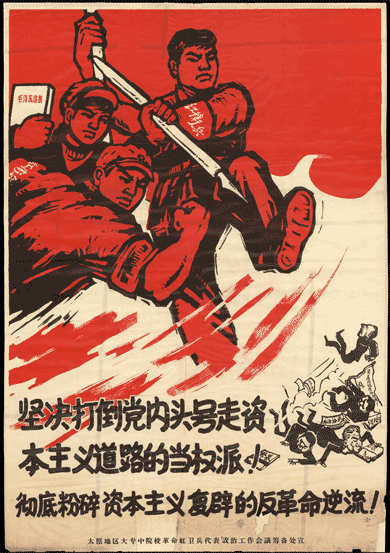 Sidney Rittenberg’s face fills the screen in a college auditorium where The Revolutionary is being shown. His eyebrows are bold brushstrokes of white above narrowed, intent eyes. His lips are firm. He has the wrinkles and gnarled neck of an old man. He does not, however, look like a man who is 90 years old, or like one battered by spending 16 of those years in solitary confinement in China for the offense, ultimately, of believing too deeply in the Party and the revolution. “If you put one drop into the long river of human history, that’s immortal … You either make a difference or you don’t make a difference,” Rittenberg says to the camera in his Southern gentleman’s drawl. This is his credo. Outside the auditorium windows, night has fallen. Rittenberg’s larger-than-life face is reflected, translucent, in the glass, as if his memory were speaking out of the darkness. “History,” he says wryly, “rolled right over me.”