Dear friends,
 Flexibility has been the watchword of the Niot Project since its inception. To help teenagers who are having a hard time learning it’s absolutely necessary, as we see it, to tailor an individual intervention plan to the individual needs of each one. But it’s also necessary to make frequent alterations, because these are young people who needs change from year to year, month to month, and even week to week. In this year of the Covid-19 pandemic, this flexibility has become all the more important. The Niot Project has adapted the help it offers to a new set of circumstances in which schools and boarding facilities close and open unpredictably and in which students and teachers have had to adjust to distance learning.
Eden Israeli, the head of the Niot Project, told us this week that over the past year the Niot Project coordinators in all the schools and boarding facilities have continued to work hard to identify students who are having problems and to provide them with help. “The coordinators report that the students having trouble this year are not necessarily those who have had trouble in school before this year,” she says. “Some strong students are having trouble learning on Zoom and doing their schoolwork.” As such, art of the coordinators’ work has been to maintain close contact with both teachers and students in order to identify those who need extra personal help or work in small groups, or simply a personal conversation. “Many of them don’t want another Zoom class,” Eden says. “They want to meet face to face.” Such meetings can happen at the boarding facilities, which have reopened, but it’s more difficult at other schools, where not all grades have gone back to school yet.

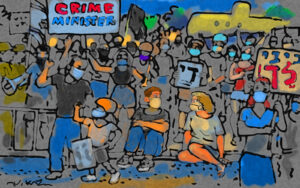
 “Alas, she become a harlot, the faithful city” laments the prophet Isaiah (1:21) in the haftarah for Shabbat Hazon, the Shabbat preceding Tisha B’Av. Isaiah is not the only prophet to portray the city of Jerusalem, and the people of Israel, as a harlot—it is a motif that other prophets also use. The most notable of these is Hosea, in whose book it constitutes the underlying metaphor. On the face of it, the comparison seems simple. There are women who are unfaithful to their husbands and who lie with other men, either to satisfy their sexual passions or to earn money. When the people of Israel worship other gods and act in violation of the values of the Torah, they are like harlots.